
By Feran, Founder of DigibleReviewed September 2026
Bible Study for Women: Make Room for Your Own Reflections
If you're looking for a women's Bible study routine that leaves space for your questions, creativity and prayers, start with a passage and a place to write. You can use a paper Bible and notebook or journal digitally on a tablet. The page can be beautiful, simple or unfinished. It only needs to help you spend time with Scripture.
This is a practical starting routine, not a separate Bible translation or a prescribed course. Use it for your own quiet time or as a reflection structure alongside your women's study group.
A simple session to try today
- Read a short passage in context. Choose a paragraph or a chapter. Read it once before marking anything. Notice who is speaking and what happens before and after the verse that catches your attention.
- Mark one thing you notice. Highlight a repeated word, a question or a line you want to understand. You don't need a colour system for the whole Bible before you begin.
- Write in your own words. Summarise what the passage says. Then separate that observation from a personal response: “This makes me think about…” or “I want to understand…”
- Leave room for prayer. Write one prayer connected to your reflection. A sentence is enough. Add the date if you want to return to it later.
- Choose what comes next. Note a question to discuss with your group or choose the next passage. An unanswered question is a useful place to continue.
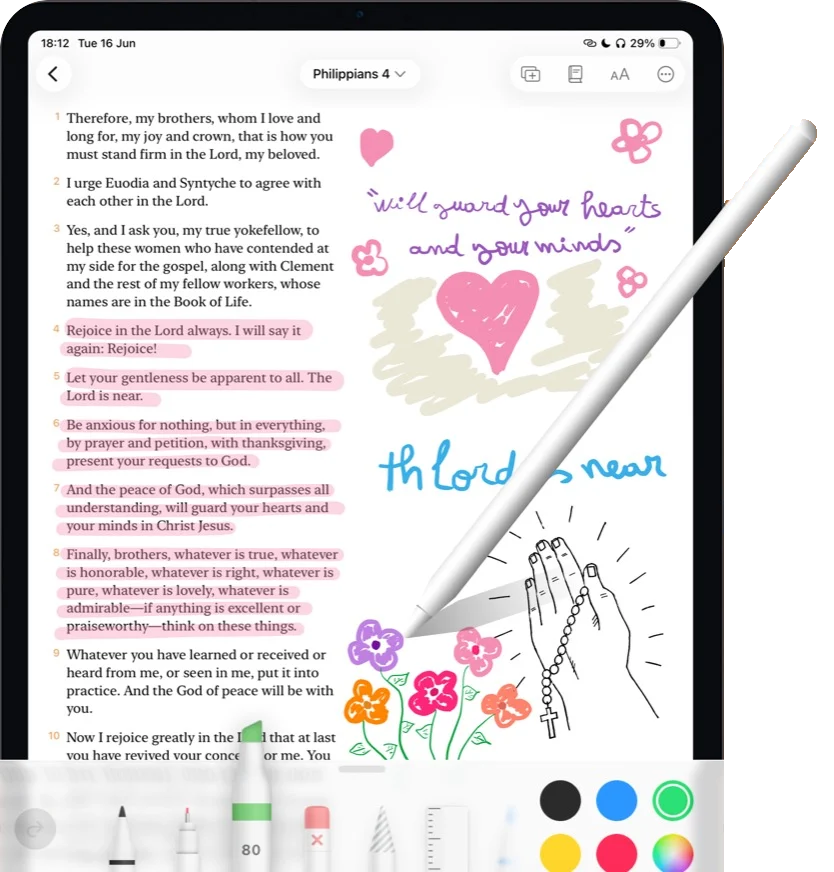
Make the page inviting without making it a project
Choose two or three colours you enjoy and give each a job. You might use one for observations, one for questions and one for prayers. Keep a small key on your page. Our Bible colour coding guide offers more ideas if you want a fuller system.
A heading, a little lettering or a sticker can make a page feel personal. Leave space for later thoughts rather than trying to finish every corner. If a page stays mostly text, it still holds your study. For a collection that grows over time, follow the loaded Bible tutorial.
Bring your own questions to a women's study group
Before you meet, write the passage reference, one observation and one question. Leave a section for notes from the conversation and another for your own response afterwards. Keep prayer requests private and consider what belongs only in your personal journal before sharing a page.
If you prefer a repeatable structure, try SOAP: Scripture, Observation, Application and Prayer. You can keep that structure while changing the colours and layout each week.
Choose the device that fits how you study
On iPad, Digible lets you write and draw directly on Scripture with Apple Pencil. Android tablets support stylus journaling too. On iPhone and Android phones, you can read, highlight verses and keep typed notes. Choose a tablet if the handwritten pages are the experience you're looking for.
Digible is free to download with a limited preview. Continued reading and journaling require Digible Pro. You can use the routine above with a Bible and notebook you already have, too.